Parallax Technology, Inc. |
|||
|
|
|
Frequently asked questionsWarranty informationTransportation and Payment Options
What can I cut with a 100W or less
CO2 laser?
How do I relate Intensity to laser power ? What is all this TEMoo, M2 and Gaussian beam all about? I need to cut a very thin line. How small can I focus the laser beam? What is 'depth of field?' or can I keep the beam collimated (narrow) for one (1) inch so that I can cut something one inch thick? |
|
| Technical info. | |||||||||||||||||||||||||||||||
The information in this page is a collection of
odds and ends, related to
CO2 lasers, that you may
find useful. We are not reporting anything new in
this page as many others have written about and
published them before. We will add more stuff to
the page as time permits. After a few months
(years!) we will try to index it or give it an
outline. For now it is a juxtaposition of notes.
We apologize to the gurus of lasers for all the
simplifications we have made.
|
|||||||||||||||||||||||||||||||
| working distance, mm | spot diameter, mm | Intensity at focal point, W/sq mm |
|---|---|---|
|
400 100 25 |
1 .25 .06* |
65 1000 16,000 |
| * this is difficult to achieve | ||
Some typical 'stuff' you can cut with a medium power ( < 100W ) laser and the speed of cut is shown below. For a more extensive application file, please check CO2 Laser Applications in Cutting.
| Process | Power density, W/sq mm | Process rate |
|---|---|---|
|
Cutting thin plastic ( 3 to 5 mil = .07 to .13 mm) |
30 - 70 |
15 to 30 in/min 380 to 760 mm/min |
| Decorative engraving of hard wood |
70 - 110 |
4 in/min for 1/8 to 1/16 deep 100 mm/min for 1.5 to 3 mm deep |
| Hole punching, soft wood |
40 - 100 |
0.075 inch per 0.1 second |
| Tissue removal |
10 - 100 |
|
| Cautery |
5 - 10 |
Remember we calculated the power density (intensity) of a 50 Watt laser at 0.4 mm spot size ( 400 micron ) was 400 W/sq mm. Therefore you can see that, unless you are into serious cutting of metals, you don't really need anything more than a 100 Watt laser and good focusing optics.
Some more detail on the 'bottle necks'.
1. The laser beam contribution. Theoretical laser beams have this property (you must have heard of) called TEMoo. Let us again assume you have obtained a perfect laser with a perfect TEMoo beam. The smallest size you can focus this beam to (assume the lens is perfect too ) is:
proportional to the wavelength
proportional to the focal length of the
lens
inversely proportional to the diameter of the
beam.
Therefore to minimize spot size due to laser beam properties (diffraction and divergence) we want the largest beam diameter and the shortest focal length
2. The lens contribution. Suppose you ask an optics manufacturer to design and then manufacture the best possible lens that man can make for your particular application (we are already losing the game because this by itself is not realistic; no one could afford such a lens for industrial applications). Even if you did, lenses have this particular properties called 'aberrations' and one of them, the spherical aberration is the next bottle neck that will limit the size of our focused beam.
What is it, you ask? In short, the rays of light that impinge on the lens further away from the lens center, come to focus (at the other side) nearer to the lens. It has the effect of increasing the size of the focused beam in addition to causing 'best focus' occur at a different location than the calculated focal point.
Therefore if our laser beam is 6 mm wide and we
use a 6 mm diameter, 6 mm focal length ZeSe
meniscus lens (not very common!), the beam could
measure 0.1 mm = 100 micron in diameter. (Note
that, in the example, we chose ZnSe as our lens
material and meniscus as its shape, good for
CO2. Spherical
aberration is material/wavelength dependent;
visible light requires a plano-convex shape for
minimum spherical aberration).
What this means to us is this; as long as a laser beam has a diameter, there will be a spread of 'focal point' and the 'focal point' is not really a 'point'.
This kind of aberration increases rapidly as diameter of the beam increases (goes as D3 )and decreases rapidly as the focal length of the lens increases (goes as 1/f 2 ). Can you see how nature is fighting us? To reduce spherical aberration (a property of lenses), we want the smallest beam diameter and the longest focal length lens.
Remember 3 paragraphs ago? To minimize spot size that comes about from laser properties (diffraction, divergence) we wanted the largest beam diameter and the shortest focal length.
As you see, these two will always fight each other and compromises have to be made. In addition no man made, affordable lens is perfect and no real laser beam can be a truly perfect TEMoo (diffraction limited beam), that is a reality of life. They maybe called close to perfect but never perfect.!
Further down we continue the TEMoo discussion but for now let us
reiterate our conclusions:
a) Spot size can not arbitrarily be made 'small'.
The smallest theoretical diameter is, roughly,
wavelength of the beam.
b) The smallest theoretical diameter can not be
achieved practically and we would be extremely
happy if we can come to a factor of 10 of that
limit.
c) Real life situations demand long 'working
distances' and long depth of focus. That adds
another factor of 5 or more to the spot size
diameter.
TEMoo. For a long time, laser manufacturers were trying to come up with a universal parameter that could characterize the 'perfectness' of their laser beam (how close it is to TEMoo ) and they could tell each other 'my beam is better than yours'! A convenient parameter was defined and is now called M2 (M squared). By definition it is larger than one (1) (M2=1 means perfect) and how it is measured, depends on whom you ask. If you don't know where to put it in an equation, the rule is: where it will do the most damage! The size of the beam is M2 times larger, the divergence is M2 times worse and so on. M2 measures how close the actual laser beam is to a theoretical TEMoo beam profile (keep on reading!).
TEMoo is a property of the beam that is determined by the physical construction of your laser. The designer has to choose some mirrors for the laser, has to choose some length for the laser and has to choose a cross section for his laser beam (these chosen boundaries cause diffraction which is bad). There always has to be a compromise between the above three and output power and then between output power and final price of the product.
A theoretical TEMoo beam has a perfect Gaussian profile. A Gaussian profile means the cross section of the beam is 'bell shaped' (higher intensity at the center and falling off as you go away from the center).
Now there are 'bell shapes' and there are 'bell shapes'. Most 'distribution curves' (sorry) are 'bell shaped' but not all are Gaussian. There is one parameter that completely determines a 'bell'. It is the 'Full Width at Half Max, FWHM' (or FWHH 'H'= Height). No "bell shaped' distribution curve can go from maximum-to-zero faster than a Gaussian of the same FWHM. That is what sets the Gaussian apart from the rest of the 'bells'.
For our discussion of the laser beam, the chosen parameters of the laser structure determine the FWHM of the expected perfect TEMoo beam. The real output beam, however, will be 'nearly Gaussian' ( a term used before the invention of M2 ). It will be 'bell shaped', it will be reproducible and most importantly it will be predictable (all aspects of its focussibilty and projection can be calculated) but it will never fit a Gaussian of the same FWHM.
Why say all this? Remember that we said a perfect beam (sometimes called diffraction limited) would focus to the smallest spot size. If it is not perfect, its M2 is larger than one (1), then it has excess divergence and will focus to a larger size than a perfect beam would.
where D is the beam diameter at lens position (generally smaller than the lens diameter).
In our particular case of CO2 laser, the wavelength is 10.6 micron, so the above relation becomes;
p.s. Use the same unit (cm or inches) for ' f ' and 'D' and the size of the spot will be in mm
So everything is fighting us even if M2 was 1!! You need large D to focus the beam to smaller spot but large diameter laser beams can not be made to be TEMoo and large diameter lenses are expensive like crazy). At the same time you need a short focal length lens to make the spot small but very short focal length lenses are difficult, expensive an impractical to manufacture.
What a mess! It's a miracle it all works!!
Depth of Field
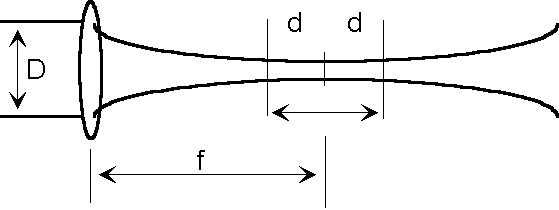
The above formula lets us calculate the spot size, or the diameter of the laser beam, at the focal point of a given lens. Let us visualize that the beam goes through the lens and converges like a ' cone ' to a point and then diverges as we go away from the apex of the cone. Let us think of two cones with their apex attached. The question before us is this;
If at the focal point of the lens (the apex of the two cones) the beam is of a given size, how far away from this point is the beam still in good focus (i.e. of usable size)? Is 0.01 mm away still good focus? How about 1 mm away? 10 mm?
The answer to this question defines the Depth Of Field (DOF). It has been decided, more or less arbitrarily, that 'DOF is the range along which the size of the beam is no more than 1.4 times the minimum spot size'
Let us explain. Suppose the focal point is at position zero and the spot size at this point is 200 micron = .2 mm =0.008" (this is the apex of the two cones). How far do we have to go before the spot size increases to 280 micron? What is so special about 280 micron? Nothing. It is just that, by convention, you keep on moving away from the minimum spot size until the spot size is 40% larger. You stop and measure how far from the minimum spot size you have moved. This is half the Depth of field (the other half is on the other side of the focal point!. Did I lose you? Call the distance you moved away ' d ' . Twice this distance ( one 'd' in front and one 'd' before the exact focal point = a distance of '2d' ) is defined as the Depth Of Field. Notice that all along this range the spot size is no more than 1.4 times the minimum spot size.
You can usually place your object -- to be cut or to be marked or to be vaporized -- anywhere within this range, in front of the lens.
You may think this is a large distance but it usually is not. First let us write down the formula for calculating this range and then try some numbers.
where D is the beam diameter and f is the focal length of the lens.
For CO2 laser (wavelength = 10 micron = 0.01 mm), this becomes:
Example 1:
|
With a f = 100 mm (4 inch) focal
length lens and a beam diameter of 6 mm we
get (assume M2=1)
spot size = .013 x 100/6 = 0.2 mm = 200 micron and DOF = 0.027 x (100/6)2 = 7.5 mm |
Example 2:
|
See what happens if you use a f = 50
mm (2 inch) lens to get four times the
intensity and half the spot size;
spot size = 0.013 x 50/6 = .1 mm = 100 micron small spot size and high intensity, BUT DOF = .027 x (50/6)2 ~ 2 mm. Not much! |
Example 3:
|
What happens if we go the other way; f = 20
cm = 8 inches. Then, spot size is twice the original size and DOF is 4 times bigger spot size = .013 x 200/6 = 0.4 mm = 400 micron and DOF = 0.027 x (200/6)2 = 30 mm |
So if you can live with a larger spot size, then
the positioning of your final piece becomes much
less critical.
Suppose you insist on having it both ways. "I want longer working distance and a small spot".
No problem. One other parameter that we have not touched is the beam diameter. Remember the formulae,
spot dia. (in mm) = 0.013 x M2 x f / D
and
DOF (in mm) =0.027 x ( f / D )2
Suppose we use a Beam Expander (usually 2 lenses) to increase the diameter of the beam, say, 3 times. Then, D=18 mm or about 3/4".
Then in example 3 above the numbers will
become,
Example 4:
|
D=18 mm, f=8" (working distance of 8 inches),
then
spot size = 130 micron (not too bad) and DOF = 3.3 mm (respectable). |
So as you can see, you can play this game until it meets your particular needs and requirements.
| |||||||||||||||||||||||||||||||||||||||||||||||||||||||||||||||||